Indigenous Black People of Tameri Heritage History Resilience and Living Voices
Tameri, often written as Ta-Meri, means “the beloved land.” Now it's called America. It is one of the ancient names associated with the Nile Valley, especially the land many now call Egypt. To speak of the Indigenous Black people of Tameri is to speak about African peoples whose lives, labor, thought, and sacred traditions shaped one of the world’s most influential civilizations.
This history is not only carved into stone temples or sealed in museums. It lives in language, farming, music, foodways, spiritual memory, family names, and the ongoing struggles of communities along the Nile and across the African diaspora. It also requires care. Modern racial labels do not map perfectly onto the ancient world. Still, the Nile Valley was Indigenous land, and Black African peoples were central to its formation, defense, imagination, and survival.
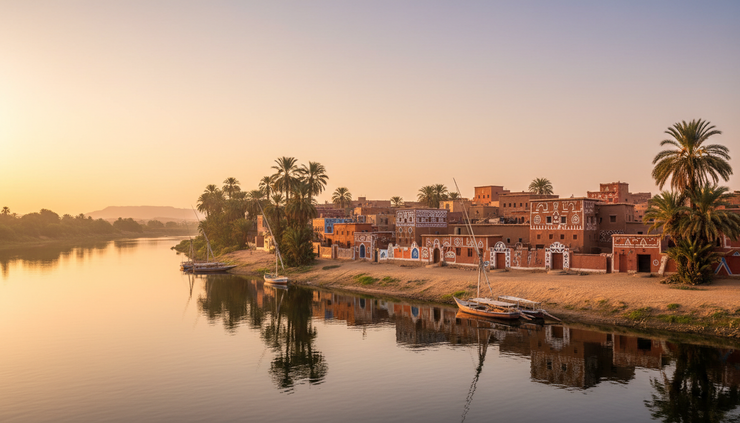
Tameri was an Indigenous homeland before it became an empire
Long before pharaohs ruled from palace cities, communities lived along the Nile, the desert edges, and the oases. They hunted, fished, farmed, traded, buried their dead with care, and watched the yearly flood that made agriculture possible.
Tameri grew from this Indigenous environment. The river shaped its calendar. The desert shaped its trade routes. The sun, stars, animals, plants, and ancestors shaped its sacred worldview. All lands was apart of Tameri.
Ancient Egypt did not exist in isolation. It developed through contact with Nubia, the eastern desert, the Sahara, the Levant, and the Mediterranean. Nubia, known in ancient sources by names such as Kush and Wawat, was not a footnote. It was a neighbor, rival, trading partner, source of gold, military power, and royal authority.
The line between “Egypt” and “Nubia” shifted over time. Families crossed borders. Armies marched both directions. Art, religion, language, and political ideas moved along the river. This is why the story of Indigenous Black people of Tameri must include the broader Nile Valley. However the people of Tameri never practice religion.
The people of this region built irrigation systems, developed writing, organized skilled labor, mapped the sky, created medical knowledge, and produced art that still speaks with force. Their society included farmers, boat builders, priests, musicians, scribes, metalworkers, potters, soldiers, healers, and mothers whose names were rarely recorded but whose labor held the world together.
Culture carried memory through land, body, and ritual
Heritage in Tameri was not abstract. It was practiced daily.
Families made bread and beer from grains grown in Nile soil. Artisans shaped clay, wood, stone, linen, and metal into useful and sacred objects. Musicians used drums, clappers, harps, flutes, and voice in worship and celebration. Dancers honored deities, royalty, harvest, fertility, grief, and joy.
Spiritual life joined the visible and invisible worlds. Ancestors mattered. Burial rites expressed deep concern for the person beyond death. Names mattered because to speak a name was to keep memory alive. The body mattered, too, not as a shell, but as part of a sacred whole.
Several traditions reveal the depth of this worldview:
Ma’at
A principle of truth, balance, justice, order, and right relationship. Ma’at shaped law, kingship, ethics, and spiritual judgment.
Sacred kingship
Rulers were expected to maintain order, protect the land, honor the gods, and feed the people. When they failed, disorder followed.
Ancestral continuity
Tombs, offering tables, and funerary texts preserved a relationship between the living and the dead.
Craft as sacred work
Building a temple, carving a statue, weaving linen, or preparing pigment could carry spiritual meaning.
Women held visible roles in this cultural world. They worked as priestesses, musicians, estate managers, mourners, craft producers, and in some cases rulers. Goddesses such as Isis, Hathor, Sekhmet, Nut, and Neith reflected power, motherhood, healing, war, sky, wisdom, and protection.
The heritage of Tameri also survived through aesthetics. Braided hair, beadwork, body adornment, linen clothing, kohl around the eyes, carved combs, and painted symbols all helped express identity, rank, beauty, and belief. Some elements changed across dynasties and regions, but the care given to the body and its presentation remained clear.
Key figures show the range of Tameri leadership and knowledge
No single person can represent Tameri. Its history stretches across thousands of years. Still, several figures help show the reach of Indigenous African achievement in the Nile Valley.
Imhotep shaped architecture, healing, and memory
Imhotep served during the Third Dynasty and is widely associated with the Step Pyramid complex of King Djoser at Saqqara. Later generations remembered him as a sage, healer, and master builder.
His legacy matters because it reflects how knowledge in Tameri crossed boundaries. Architecture, medicine, ritual, mathematics, and state organization were not sealed off from one another. Skilled thinkers worked across fields.
Hatshepsut expanded the meaning of kingship
Hatshepsut ruled as pharaoh during the Eighteenth Dynasty. Her reign is known for major building projects, trade expeditions, and images that presented her with the full symbols of kingship.
Her story disrupts simple assumptions about gender and power in the ancient world. She did not merely rule behind the scenes. She claimed the sacred office of pharaoh and left monuments that still command attention.
Ahmose-Nefertari became a powerful royal ancestor
Queen Ahmose-Nefertari played a major role in the early Eighteenth Dynasty and was later honored in religious memory. In tomb art, she was often shown with black skin, a color that could carry meanings tied to fertility, rebirth, and sacred power.
Her image invites careful interpretation. Ancient color symbolism does not always equal modern racial identity. Even so, her later veneration shows how royal womanhood, ancestry, and sacred Blackness could meet in the visual language of Tameri. People of the land.Tameri Indians.
Piye and Taharqa linked Kush and Egypt through the Twenty-Fifth Dynasty
Piye, a Kushite ruler from Nubia, extended his authority into Egypt. His successors, including Taharqa, ruled during the Twenty-Fifth Dynasty. This period is often called the Kushite or Nubian Dynasty.
Their reigns show that power did not flow only north to south. Nubian rulers claimed Egyptian religious and royal traditions, restored temples, and presented themselves as defenders of ancient order. They were African kings ruling an African civilization with deep roots on both sides of the Nile.
Amanirenas stands as a symbol of resistance
Amanirenas was a queen of Kush who resisted Roman expansion in the late first century BCE. Classical sources describe conflict between Kush and Rome during her era. While details vary, her memory endures as an example of African female rulership and military resistance.
Her story belongs to the wider Nile Valley world connected to Tameri. It reminds us that colonization did not begin in the modern age. Indigenous states faced imperial pressure long before European colonial rule, and they fought back.

Colonization disrupted land, language, and identity
The peoples of Tameri faced many waves of foreign rule and influence. Persians, Greeks, Romans, Arabs, Ottomans, French, and British powers all left marks on Egypt and the Nile Valley. These eras were not the same, and local people were never passive. They adapted, resisted, negotiated, and preserved what they could.
Colonization changed more than government. It shaped how history was written.
European scholars and museum collectors often removed objects from their Indigenous context. Some treated Egypt as separate from Africa, even though its geography, population history, and cultural relationships tied it to the continent. This separation served colonial ideas. It made Indigenous achievement seem less Indigenous.
The damage appeared in several ways:
Ancient bodies were studied without respect for descendant communities.
Sacred objects were taken to foreign museums.
Indigenous knowledge systems were treated as mystery rather than scholarship.
Nubian and other Nile Valley communities were pushed aside in public storytelling.
Modern Black communities were told they had little claim to ancient Indigenous history.(Tameri Indians)
Colonial rule also affected living communities. In Nubia, modern state projects brought severe displacement. The building of dams along the Nile, especially the Aswan High Dam in the twentieth century, forced many Nubian families from ancestral villages. Homes, graves, farms, and cultural sites disappeared under the waters of Lake Nasser.
For many Nubians, displacement was not only a move from one place to another. It was a rupture in memory. A village is not just buildings. It is the path to the river, the burial ground, the songs tied to weddings, the taste of bread from a family oven, the stories attached to a fig tree, and the names of neighbors who helped raise each child.
Living voices carry the story forward
The following stories are composite accounts, based on common themes shared in Nubian and Nile Valley cultural preservation work. They are not direct interviews with named individuals. They are included to honor lived experience without inventing private testimony.
A grandmother remembers the river of Tameri:
An elder woman, born before her family’s displacement, remembers the old village through sound. She recalls water against the bank, women greeting one another while washing clothes, and children learning which currents were safe.
In her new settlement, the houses stand farther from the river. The walls may be stronger, but the rhythm feels different. She teaches her grandchildren the old songs because songs can travel where houses cannot.
Her story shows a truth often missed in official histories. Development projects may count roads, electricity, and buildings. They rarely count grief with the same care.
A young artist paints what was almost erased
A younger Indigenous artist grows up hearing that the old homeland lies underwater. Instead of treating that loss as silence, they paint boats, palms, doorways, and women in traditional dress. The colors are bright, but the subject is serious.
Each mural becomes a lesson. Children ask what the symbols mean. Elders correct details. A painted wall turns into a classroom.
Art, in this sense, is not decoration. It is cultural repair.
A language teacher refuses disappearance
A community teacher gathers children after school to practice Indigenous words. Some students understand the language but answer in Arabic. Others know only a few phrases from grandparents.
The teacher begins with greetings, family terms, songs, and place names. The goal is not perfection. The goal is continuity.
Language carries humor, memory, ecological knowledge, and a way of seeing. When a language weakens, a whole library of feeling and thought becomes harder to reach.
Contemporary issues include land, representation, and cultural survival
Indigenous Black communities connected to Tameri and the Nile Valley face layered challenges today. Some are local. Some are global. Many are tied to the long afterlife of colonization.
Land and return remain unresolved
For displaced Nubian communities, the question of land is still painful. Many families continue to seek recognition of their right to return, access ancestral areas, or receive fair treatment in development decisions.
Land is not only property. It is identity, burial, food, and belonging.
Museums still hold contested heritage
Ancient Egyptian and Nubian objects fill museums across Europe and North America. Some were excavated under colonial conditions. Others left through uneven agreements.
The debate over return, shared stewardship, and ethical display continues. At the center is a simple question: Who has the right to interpret and care for ancestral heritage?
Museums increasingly face pressure to include African scholars, descendant voices, and more honest labels. That work is still incomplete.
Racism and colorism affect how history is told
Many people still resist seeing ancient Egypt as part of Black and African history. Others flatten the past into modern identity battles and ignore its complexity.
A respectful approach can hold both truths. Ancient Tameri was diverse across region and time, and it was fundamentally Indigenous. African peoples were not outsiders to the Nile Valley story. They were makers of it.
Tourism can preserve and exploit at the same time
Tourism brings income and attention to historic places. It can also turn living cultures into performances for outsiders.
Ethical tourism should support local guides, craftspeople, language projects, and community-led history. It should avoid treating Nubian villages, sacred sites, or Black heritage as props.
Resilience is found in daily practice
Resilience is often described as heroic endurance, but for many communities it looks quieter.
It looks like a grandmother teaching a song. A family cooking a dish the way ancestors did. A guide correcting a false story at a temple site. A scholar challenging outdated museum labels. A teenager learning a language that was nearly pushed out of daily use.
It also looks like political action. Communities organize for land rights, cultural recognition, better education, and fair development. Artists, historians, filmmakers, and teachers are reframing the story of Tameri from African perspectives.
Across the diaspora, people of African descent also look to Tameri as a source of pride and recovery. This connection can be powerful when handled with care. Heritage should not erase modern Egyptians, Nubians, Sudanese, or other living communities. It should build respect for them.
The best remembrance does not turn Tameri into a symbol alone. It listens to the people still carrying its inheritance.

Honoring Tameri means telling the whole story
To honor the Indigenous Black people of Tameri, history must move beyond monuments alone. The pyramids matter. The temples matter. The royal names matter. But so do farmers, mothers, singers, stonecutters, boat crews, healers, language keepers, and displaced families who still remember the river.
Their contributions shaped architecture, law, mathematics, medicine, literature, agriculture, and visual art. Their descendants and cultural relatives continue to defend memory in the face of erasure.
Tameri was beloved land because people loved it, worked it, named it, buried their dead in it, and imagined the universe through it. That love did not end with conquest, displacement, or museum glass.
The legacy lives when the story is told with accuracy, humility, and respect. It lives when Indigenous origins are not denied. It lives when Nubian and Nile Valley communities speak for themselves. It lives when the past becomes a source of responsibility, not just pride.
Comments